
You know that scary moment: you prepared a perfect answer about your favourite hobby, then the examiner asks about a useful skill. Suddenly every sentence you memorised feels locked in the wrong room.
That does not mean you are bad at English. It means a script is too rigid for a conversation. Paper 3 rewards your ability to respond, develop an idea and keep going. The safest preparation is not a longer script. It is a smaller set of moves you can reuse.
Build in blocks, not sentences
Start with three answer blocks: your point, your reason and one real example. You can move these blocks around when the question changes. If you are asked about a useful skill, your answer might begin like this:
“I think cooking is a useful skill for teenagers.”
“The main reason is that it helps us become more independent.”
“For example, I learnt two simple dishes during the school holidays, so now I can prepare lunch when my parents are busy.”
Notice what is not here: fancy vocabulary, a dramatic introduction or five reasons squeezed together. One idea becomes convincing when you explain it clearly.
“The goal is not to sound memorised. The goal is to sound like you know what you mean.”
Aina Rahman, English learning editor
Prepare a toolkit of connectors
Connectors give your brain a second to decide what comes next. Choose a few that feel natural in your mouth: in my opinion, the main reason is, for example, on the other hand and overall. Do not force one into every sentence. Use them as signposts.
Then prepare examples from your actual life: your school, your family, your neighbourhood, a club, a game or a small challenge you solved. Real examples are easier to recall and easier to expand when your partner asks a follow-up question.
Mini lesson · 6:12
Make your answer sound alive
Teacher Farah shows where to lift, pause and land your voice.
Try this: replay one sentence, copy its rhythm, then say your own sentence with the same rise and fall.
Practise changing direction
Once your three blocks feel comfortable, do not repeat the same answer ten times. Change one condition. Swap the topic from “a useful skill” to “a school activity”. Give a different reason. Replace your example. This teaches your brain to retrieve ideas instead of reciting sounds.
Ask a friend to interrupt with “Why?”, “Can you give an example?” or “Do you agree?”. Those tiny surprises are good practice. You are building recovery, which matters more than a flawless first sentence.
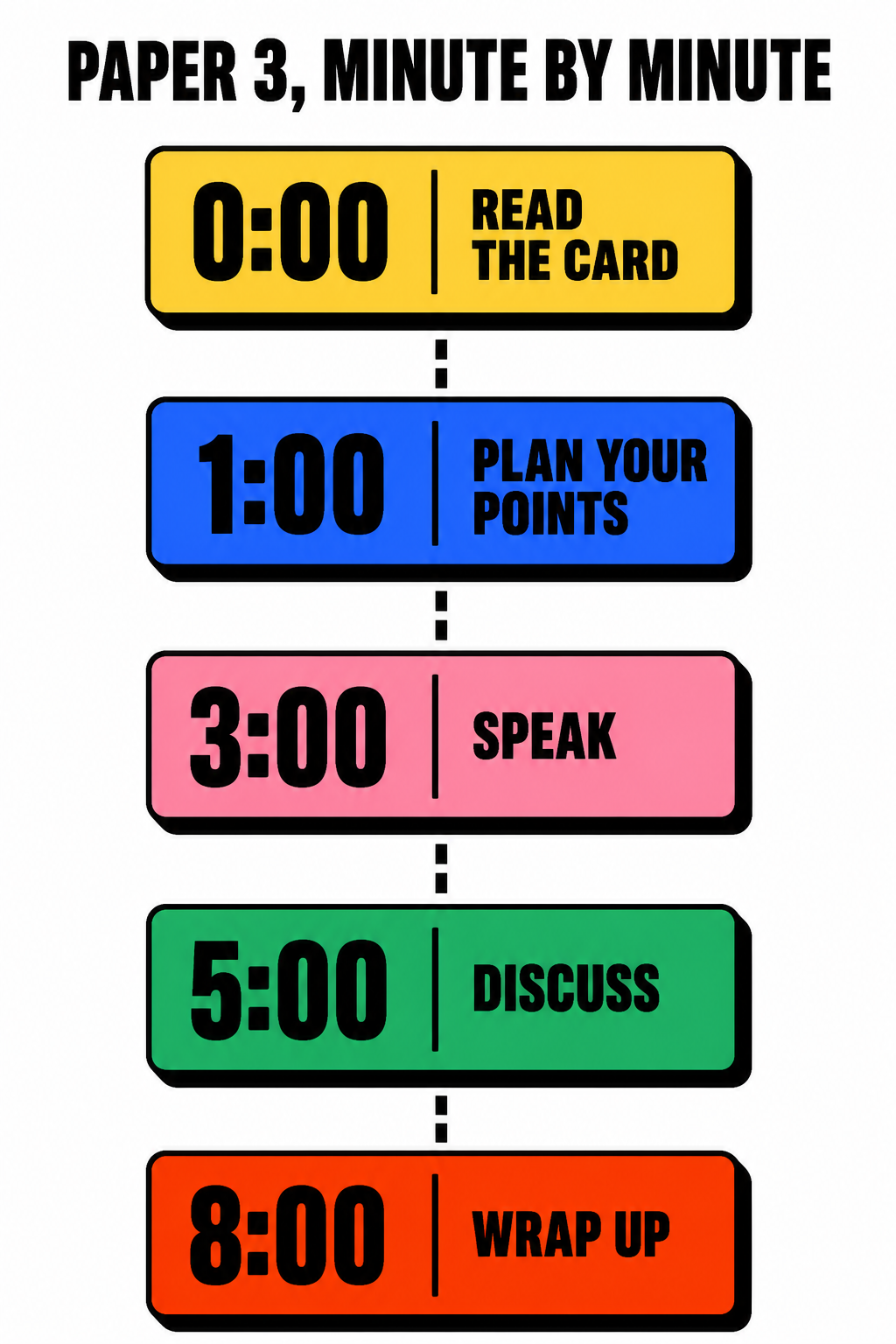
What to do when your mind goes blank
First, breathe out. A short pause feels much longer to you than it does to everyone else. Repeat the key phrase from the question — “A useful skill…” — then use a restart line: “I would say…”, “One example could be…” or “Let me explain that another way.”
If you lose a word, describe it. “The tool we use to…” keeps the conversation moving. Communication is the job. A missing word does not end your answer.
Key takeaways
- 01
Prepare moves, not scripts. Build every answer from a point, reason and real example.
- 02
Keep five connectors ready. Use them to guide your listener and buy thinking time.
- 03
Change one thing each round. New topics and follow-up questions make practice flexible.
- 04
Recover out loud. Pause, restart or describe the missing word. Keep communicating.
You do not need to become a different person in the exam room. You need a simple structure that lets your own ideas come through. Start with one two-minute answer today. Steady first. Smooth comes later.
Find another practice